ECCV 2026: Digital Art History, VISART and Spatial Reasoning
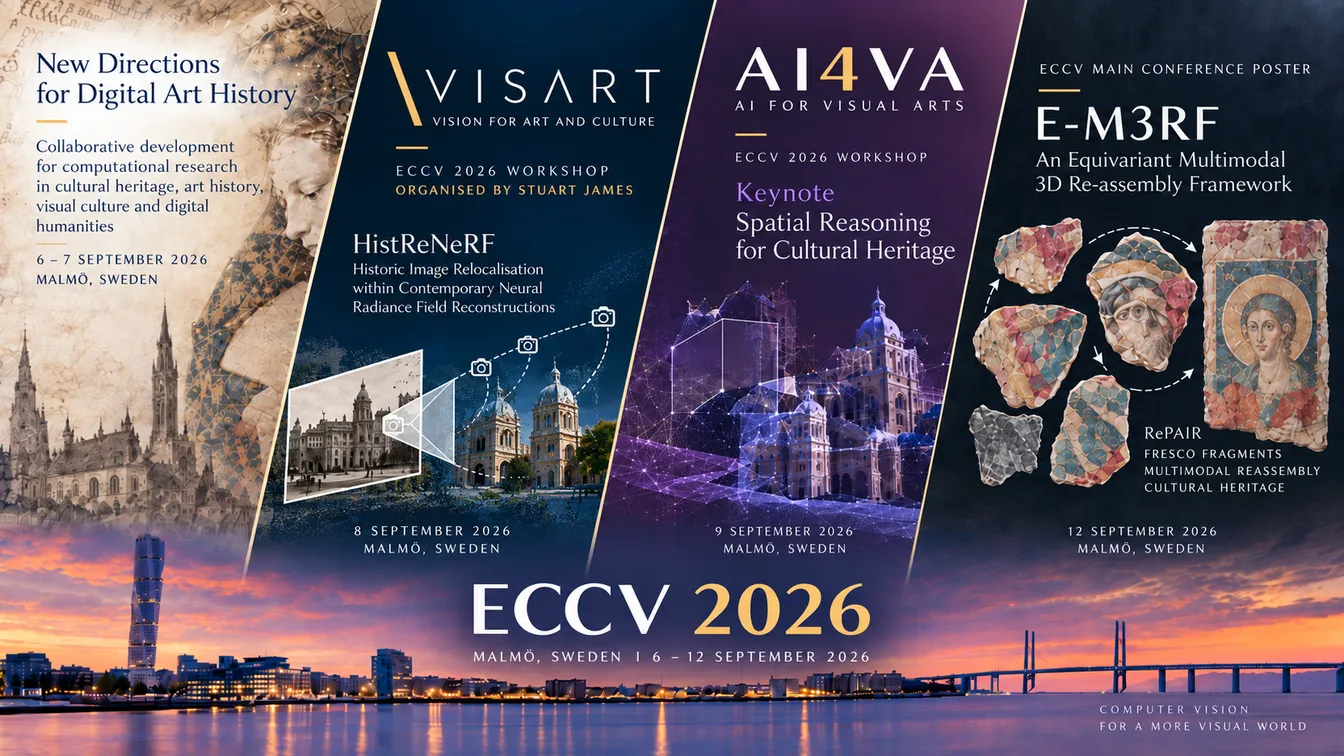
Wrapping up ECCV 2026 in Malmö turned a particularly busy week, spanning digital art history, cultural heritage, computer vision and spatial reasoning.
ECCV 2026 in Malmö turned into a particularly busy week, spanning digital art history, cultural heritage, computer vision and spatial reasoning.
The week began with New Directions for Digital Art History, a two-day collaborative workshop bringing together researchers from computer vision, art history, visual culture and digital humanities. Led by Amanda Wasielewski, and developed out of the VISART community, the event was designed to start from humanities research questions rather than from particular computational methods.
A recurring theme was that cultural heritage is not simply another application domain for AI. Historical and cultural material often exposes much harder problems around ambiguity, context, incomplete evidence and interpretation.
This flowed naturally into **Vision for Art and Culture (VISART) VIII ** workshop, which we organised at ECCV on Tuesday. VISART has been running since 2012 and continues to provide a meeting point between computer vision, cultural heritage, art history and digital humanities.
Alongside a broad programme of technical and interdisciplinary work, we presented HistReNeRF: Historic Image Relocalisation within Contemporary Neural Radiance Field Reconstructions. The work explores whether historic photographs can be positioned within modern 3D neural reconstructions of the same locations, even when the scene has changed significantly over time.
On Wednesday, I gave an invited keynote at the AI for Visual Arts (AI4VA) workshop on Spatial Reasoning for Cultural Heritage. The central idea of the presentation was simple: many traditional computer vision problems can be made more complex (and realistic) through heritage settings. With broken frescoes, fragmented objects or historic photographs, the interesting question is often not what can we recognise? but rather what can we infer about a world that is no longer fully observable? That leads towards a broader problem of reasoning from partial observations, combining geometry, appearance, semantics, context and uncertainty.
The week ended back in the main ECCV programme, where on Saturday we presented E-M3RF: An Equivariant Multimodal 3D Re-assembly Framework. The work looks at reconstructing fractured 3D objects by combining geometric and colour information within an equivariant model, with a particular focus on challenging archaeological fragments.
There was a satisfying progression across the week: from humanities-led questions, through interdisciplinary discussion at VISART and AI4VA, to a concrete technical contribution in the main ECCV programme.
The main idea I came away with is one that increasingly shapes my own research: cultural heritage is not only a beneficiary of advances in AI, but also a source of fundamental AI problems.
Incomplete objects, changing places and fragmentary historical evidence all force us to ask how intelligent systems should represent and reason about a world they can only partially observe.